
Water Line Repair and Replacement in Los Angeles: Leaks, Pressure, and Main Line Choices
Los Angeles Plumbing Pros Blog — 30 Oct 2026
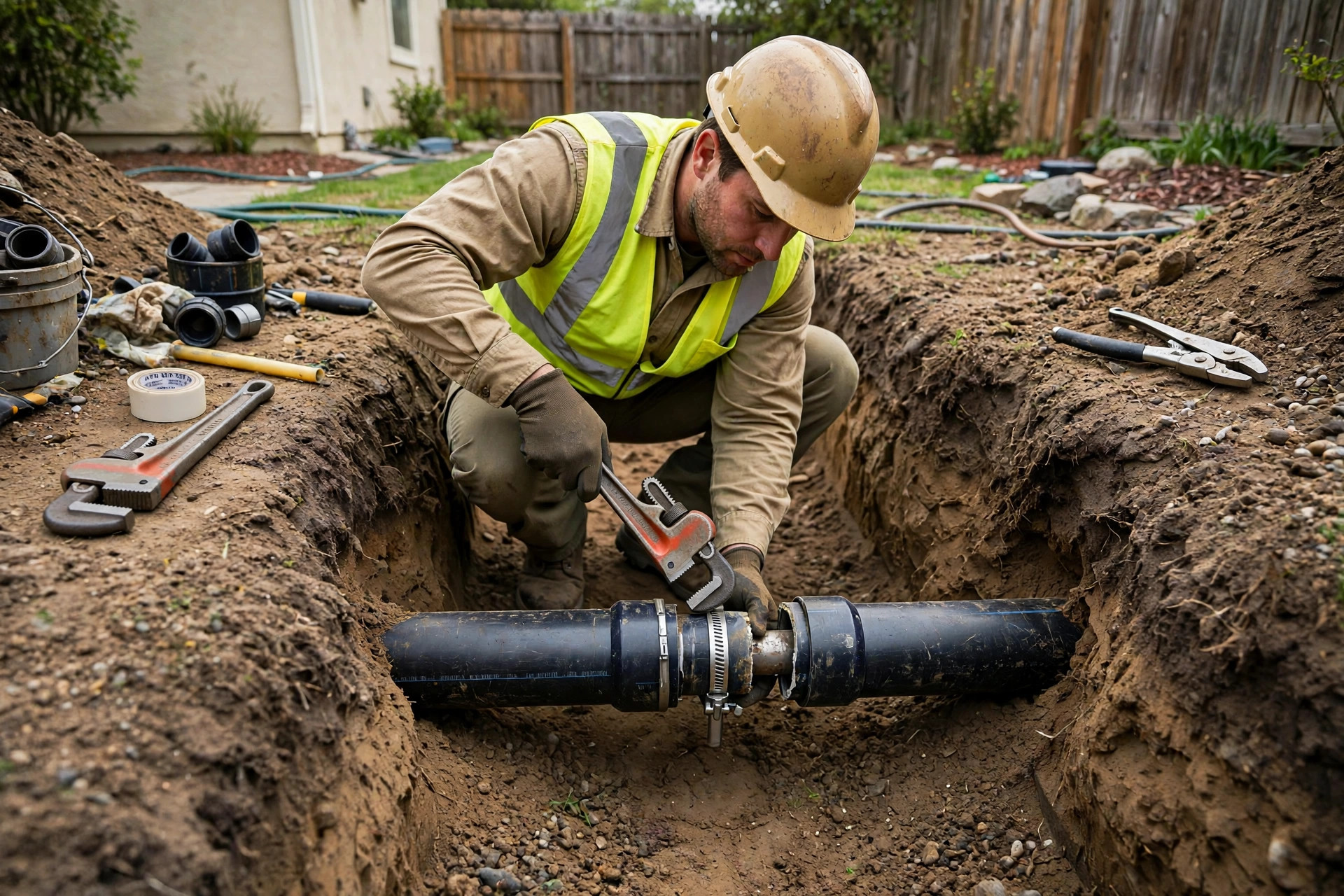
The main water line is the pipe that brings water from the street into your home, and when it fails, the symptoms can be confusing. A high water bill, a damp patch in the yard, low pressure throughout the house, or a mysterious sound of running water can all point to the same buried pipe, yet none of them proves it on its own. In Los Angeles, main lines fail for reasons tied to this city's soil, seismic movement, ageing materials, and hillside pressure, and the right response depends on locating the failure accurately before choosing between a spot repair and a full replacement. Digging in the wrong place, or replacing a sound line while missing the real leak, wastes time, money, and landscaping.
This guide explains water line repair and replacement in Los Angeles terms: how main lines are built, why they fail here, how leaks are found without needless excavation, and how repair and replacement options compare. It covers the difference between the main line and the pipes inside the house, the role of pressure over 80 PSI on hillsides, the effect of seismic movement and soil, and the special cases of Torrance slab homes and older Craftsman properties. Whether you face a sudden break, a slow underground leak, or a line that has simply reached the end of its life, a clear diagnosis should come before a shovel does.
What the main water line is, and how it differs from indoor pipes
The main water line runs from the municipal connection, usually near the street or sidewalk, to the house, where it connects to the indoor supply system. It is typically buried, often under a yard, driveway, or walkway, and it carries the full water supply for the household at street pressure before any indoor pressure-reducing valve moderates it. That position matters: a main line leak wastes water continuously, can undermine soil and paving, and can affect pressure throughout the house, while an indoor pipe leak usually affects one area and shows itself more quickly inside. Knowing which side of the house connection a problem sits on changes both the diagnosis and the repair approach.
Main line materials in Los Angeles vary by era. Older homes may have galvanized steel or copper main lines, while later installations commonly use copper or modern plastic materials, each with its own failure pattern. Galvanized mains corrode and narrow like indoor galvanized pipe, copper mains can suffer pitting and joint failure, and any buried line can be stressed by soil movement, tree roots seeking moisture, and seismic shifting. The line's depth, route, and the ground above it, whether lawn, concrete driveway, or mature trees, all affect how a leak is found and how a replacement is routed.
Why Los Angeles main lines fail: age, soil, roots, pressure, and seismic movement
Age is the most common underlying cause. A main line installed decades ago has endured years of pressure cycles, soil moisture changes, and minor ground movement, and its material has aged throughout that time. Galvanized mains from the 1948 to 1965 building era corrode from the inside, narrowing and weakening until a leak or break occurs. Copper lines can develop pinhole leaks where water chemistry, soil conditions, and age combine, and joints are often the first points to fail. Los Angeles hard water at 200 to 400-plus parts per million contributes scale and sediment inside the line, though the more decisive hard-water damage usually shows in heaters and fixtures; for the main line, corrosion and external stress often matter more.
External forces accelerate the ageing. Tree roots seek the moisture around a leaking joint and can invade or displace a buried line, especially where large street trees and yard trees grow near the line's route. Expansive or shifting soil, hillside movement, and seismic activity stress rigid buried pipe, and a line that survives one tremor may develop a weakened joint that leaks months later. Hillside pressure over 80 PSI adds a constant load that shortens the life of weakened sections and turns a small leak into a larger break more quickly. Driveway and vehicle loads over a shallow line add another stress. In practice, most Los Angeles main line failures combine several of these factors: an ageing material, a root or soil stress, and pressure that pushes the weakened point over the edge.
Signs of a main line leak, by area of the property
In the yard, look for a patch of grass that stays greener, grows faster, or stays damp when the rest of the lawn is dry, and for soft, muddy, or sunken ground along the line's route. A driveway or walkway that develops a crack, settles, or shows dampness from below can point to soil undermined by a long-running leak. Near the house, dampness at the foundation, water pooling where it should not, or a musty smell in a crawlspace can indicate a main line leak close to the entry point. In Torrance slab homes, a main line leak near or under the slab can show as damp flooring, warm spots, or unexplained moisture inside, and it can be confused with an indoor slab leak, so location matters before any repair is chosen.
Inside the house, the signs are often pressure and sound rather than visible water. Pressure that drops throughout the house, not just at one fixture, points toward the main line or the supply before it branches indoors. A faint sound of running water when all taps are off, a water meter that moves with everything shut off, and a water bill that rises without a change in use are classic main line clues. In Craftsman homes with crawlspaces, a main line leak may show first below the floor, as damp soil or staining near the entry. Noting where symptoms appear, whether they affect the whole house or one area, and whether the meter moves with taps off gives a technician a pattern that separates a main line leak from an indoor leak, a fixture problem, or a pressure valve issue.
How a main line leak is located without needless digging
Locating a buried leak starts with isolating the system, not with excavation. The meter test is a simple first step: with all taps, appliances, and irrigation off, a meter that continues to move indicates water leaving the system somewhere, and the rate of movement hints at the leak's size. Shutting off the house supply and rechecking the meter helps separate a main line leak, which sits before the house shutoff, from an indoor leak, which sits after it. Pressure testing and listening equipment can then narrow the search, with acoustic listening picking up the sound of water escaping under pressure, and in some cases ground-penetrating or camera methods help map the line's route where records are unclear.
Accurate location matters because excavation is disruptive and expensive, and digging in the wrong spot solves nothing. A line's route may not follow a straight path from street to house, and it may cross driveways, walkways, and tree roots that complicate access. In slab homes, distinguishing a main line leak outside the slab from an under-slab indoor leak changes the repair entirely, and in hillside homes, soil and slope can carry leaking water away from the actual break, making surface dampness misleading. A diagnosis that combines meter testing, pressure checks, listening, and route mapping before digging is far more reliable than one that starts with a trench and hopes the leak is inside it.
Repair versus replacement: when a spot fix is enough
A spot repair makes sense when the line is otherwise sound, the failure is local, and the cause is clear. Examples include a single damaged joint, a section cracked by a root or a one-off ground stress, or a fitting that failed while the rest of the line shows good pressure, good flow, and no other leak signs. A spot repair limits excavation, preserves landscaping and paving, and restores service quickly, and for a relatively young line with a single failure point, it is often the most sensible and economical choice. The repair should address the cause, not just the hole: a root-damaged section needs root management, and a pressure-damaged section needs pressure checked, or the same spot may fail again.
A spot repair becomes short-sighted when the line is ageing throughout, when leaks have already occurred in more than one place, or when the material is galvanized and corroding system-wide. In those cases, each repair fixes one weak point and leaves the next-weakest point to fail, often within months, and repeated excavation damages the yard and driveway more than a single planned replacement would. The decision should weigh the line's age and material, its leak history, pressure readings, and the condition of the rest of the line as far as it can be assessed. A line with a single, well-understood failure is a repair candidate; a line with a pattern of failures is a replacement candidate, even if the current leak looks small.
Full replacement options and route choices
Full replacement means installing a new main line from the connection point to the house, and the route is a major decision. A traditional open-trench replacement excavates along the new route, which is straightforward and allows full inspection, but it disrupts lawns, walkways, and driveways along the way. Trenchless methods, where suitable, can install a new line with far less surface disruption by pulling or boring along a path, though suitability depends on soil, existing line condition, obstacles, and local constraints, and not every property is a good trenchless candidate. The right method depends on the yard, the driveway, tree locations, soil, and the line's depth and route, not on a general preference for one technique.
Material and sizing choices also belong in the replacement plan. The new line must carry the household's peak demand without excessive pressure loss, and it must suit Los Angeles soil and seismic conditions, with proper bedding, depth, and joint protection. The connection at the street and the entry into the house, including shutoff and pressure control, should be renewed or verified as part of the job, because a new line connected to a failing shutoff or an uncontrolled hillside pressure over 80 PSI inherits the old system's risks. Landscaping, paving, and irrigation restoration should be discussed before work starts, so the household knows what will be disturbed, what will be restored, and what will need time to recover after the line is in the ground.
What to check before you call, and how to limit damage meanwhile
Before calling, run through a few checks that sharpen the diagnosis. Note whether pressure has dropped throughout the house or only at one fixture, whether the water bill has risen, and whether any yard, driveway, or foundation dampness has appeared and where. If you can safely read the meter, note whether it moves with all water off, and note the time and rate if it does. Turn off irrigation and check again, because an irrigation leak can mimic a main line leak and waste water in the same way. Note recent events: nearby digging, a tremor, a large tree removal, or a sudden pressure change can all precede a main line failure and help explain it.
If a leak is suspected, avoid running water unnecessarily and know where the house shutoff is, so supply can be stopped if a break worsens or water begins to damage the foundation or slab. Do not dig blindly around a suspected leak, especially near gas, electrical, or sewer lines, and do not ignore a large or growing damp patch, because undermined soil can settle paving and damage foundations over time. Photograph damp areas, meter readings, and any settling, with dates, because that record helps the technician and documents change over time. If water is entering the home, entering a crawlspace in volume, or threatening electrical systems, prioritise stopping the water and getting help rather than investigating the buried line yourself.
Prevention and maintenance for a Los Angeles main line
Main lines need less frequent attention than heaters, but they are not maintenance-free. Periodic pressure checks are the simplest habit, especially on hillsides where pressure over 80 PSI should be controlled by a working pressure-reducing valve. A valve that drifts upward exposes the main line, indoor pipes, fixtures, and heaters to excess stress, so a pressure reading that has crept up deserves attention before a leak forces it. Tree planting deserves thought too: large trees planted directly over or beside the main line route will seek moisture as they mature, and keeping major root zones away from the line reduces future root pressure and invasion.
Water use and billing patterns are an early warning system. A bill that rises without a change in household use, or a meter that moves with everything off, should be investigated promptly rather than paid and forgotten, because a small underground leak wastes water for months before it shows on the surface. After seismic activity, a quick check for new dampness, pressure change, or meter movement is prudent, even if nothing is visibly wrong. In older homes with galvanized mains, a long-term plan should assume replacement will eventually be needed, and budgeting and routing discussions can happen calmly before a break forces them. A main line that is monitored for pressure, billing, and surface signs usually gives warning before it fails catastrophically.
City-by-city notes for main line work
Older neighbourhoods in Pasadena, Glendale, and central Los Angeles often have the oldest main lines, with galvanized or ageing copper mains, mature street trees, and remodel histories that make route mapping important. Torrance and Long Beach slab homes add the under-slab question to every main line diagnosis, because a leak near the slab entry must be located precisely before it is treated as a main line or an indoor slab problem. Hillside areas across the city, from the Hollywood Hills to parts of the Valley, combine steep soil, movement, and pressure over 80 PSI, so main line replacement there must include pressure control and soil-aware routing, not just a new pipe in the old trench.
Santa Monica and coastal areas may face different soil and water table conditions, and condo or townhome main lines often involve shared or building-managed sections that change who is responsible for which part of the line. In the San Fernando Valley, larger lots and longer main line runs mean more yard, driveway, and irrigation to navigate, and trenchless suitability often depends on those long runs and their obstacles. Across all these areas, the same principle holds: locate first, then choose repair or replacement based on age, material, leak pattern, and pressure. A main line plan that names the neighbourhood's soil, trees, pressure, and housing type will be more accurate than a generic plan that treats every buried line as the same.
Restoration after main line work
Restoration is part of a main line job, not an afterthought, and it should be discussed before excavation begins. Backfill must be compacted properly so the ground does not settle into a dip months later, paving and walkway sections should be restored to match their surroundings as closely as possible, and lawn or planting disturbed by the trench needs time and watering to recover. Irrigation lines crossed by the trench should be reconnected and tested, because a sprinkler zone that stays dry or floods after main line work is a common loose end. The household should know which areas will settle or need reseeding, and which will be fully restored, so expectations are set before the first shovel.
After the new line is live, pressure should be checked at several fixtures, the meter should be confirmed still with everything off, and the household should keep a record of the new route, depth where known, and connection points. That record prevents accidental damage during future digging, fencing, or tree planting, and it helps any future technician locate the line without exploratory excavation. Watch the restored ground for settling, dampness, or paving movement in the weeks after the job, especially after rain, and report changes promptly rather than assuming they will settle on their own. A main line replacement that ends with testing, restoration, and a route record protects both the yard and the pipe beneath it.
Frequently asked questions
How can I tell if a leak is in the main line or inside the house?
A meter test helps: with all water off, a moving meter points to a leak somewhere, and shutting off the house supply separates a main line leak before that shutoff from an indoor leak after it. Pressure patterns and dampness location then narrow it further.
Does a main line leak always show as a wet yard?
No. Leaks can drain into soil, follow a slope away from the break, or run under paving without surface dampness for a long time. A rising bill, falling whole-house pressure, or a moving meter can appear long before any wet patch.
Is trenchless replacement always better than digging a trench?
Not always. Trenchless methods reduce surface disruption where suitable, but soil, obstacles, line condition, and route constraints decide suitability. An open trench allows full inspection and may be the better choice on some properties.
Should I replace the whole main line after one leak?
If the line is young, sound elsewhere, and the failure has a clear local cause, a spot repair is often sensible. If the line is ageing, corroding throughout, or has leaked before, full replacement usually avoids repeated excavation and emergencies.
Related service
Call Los Angeles Plumbing Pros
If you are seeing the signs in this post, describe what you see, where it is, and when it started. A technician will talk through the next step before any work starts.