
Water Heater Repair in Los Angeles: Hard Water, Common Faults, and Repair vs. Replacement
Los Angeles Plumbing Pros Blog — 30 Oct 2026
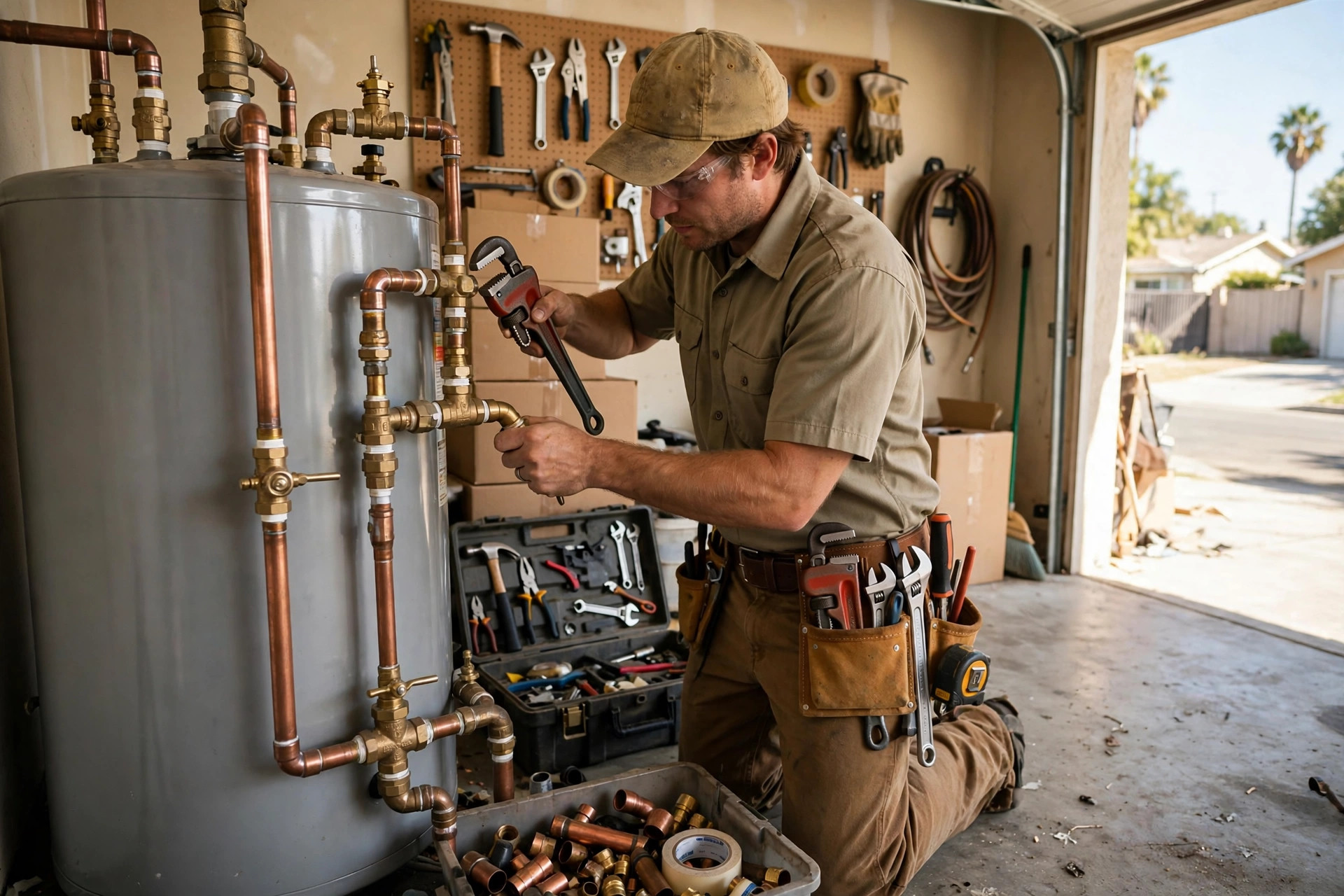
When a Los Angeles water heater stops delivering reliable hot water, the problem is rarely just age. It is usually the result of years of service in hard water, in a home whose pipes, pressure, and usage patterns have all shaped how the heater wore out. Water heater repair in Los Angeles therefore starts with diagnosis: understanding whether the heater is failing to heat, heating unevenly, leaking, making noise, or simply running out of hot water too soon, and tracing that symptom to its cause. A heater that rumbles with scale, a pilot or ignition system that will not stay lit, a thermostat that no longer holds temperature, a relief valve that drips, or a tank that shows rust at its base each points to a different repair, and some point to replacement rather than repair. This post explains those distinctions in Los Angeles terms, with the hard water, housing, and pressure conditions that make heater problems here distinctive.
The stakes are practical. A heater that fails completely leaves a household without hot water for showers, laundry, and dishwashing, and a leaking tank can damage a garage, laundry room, or closet floor, and in a multi-storey home, the unit below. At the same time, not every heater problem requires a new heater. Many common faults, from a spent heating element to a faulty thermostat, a clogged burner, or a failed igniter, can be repaired, provided the tank itself is sound. The key is an honest assessment of the tank, the age of the unit, the hardness of the local water, and the condition of the surrounding plumbing, including galvanized lines from the 1948 to 1965 era and hillside pressure over 80 PSI, before deciding between repair and replacement.
How Los Angeles hard water damages heaters
Los Angeles water commonly measures 200 to 400-plus parts per million of hardness, and in Glendale it runs over 12 grains per gallon, which is firmly in the very hard range. That hardness is dissolved calcium and magnesium, and every time a heater warms water, a little of that mineral drops out as scale. In a tank heater, scale settles on the bottom of the tank, coats electric elements, and insulates the water from the burner or element below. The heater must then run longer and hotter to deliver the same temperature, which stresses the tank, wastes energy, and produces the popping and rumbling sounds many Los Angeles homeowners recognise. Over time, the overheated tank bottom can weaken the glass lining, and once that lining cracks, the steel tank begins to corrode.
Tankless heaters are affected differently but no less seriously. Their heat exchangers have narrow passages that scale quickly in hard water, reducing flow, causing temperature swings, and triggering error codes or shutdowns if descaling is neglected. A tankless unit in a hard water area that has never been descaled can lose efficiency within a few years, even though its design life is longer in soft water. The lesson is the same for both types: in Los Angeles, heater maintenance is not optional. Annual flushing for a tank, or descaling for a tankless unit, removes scale before it becomes a thick crust, and checking the anode rod in a tank heater protects the tank from corrosion once the lining is stressed. A home with a water softener will scale a heater more slowly, but a softener does not remove scale that is already present, and a scaled heater may still need repair or replacement before a softener can protect a new unit.
Common water heater faults and what they mean
A heater that produces no hot water at all has a different set of likely causes than one that produces lukewarm water. In a gas heater, a pilot that will not stay lit, a faulty thermocouple, a failed igniter, or a gas control problem can prevent heating altogether, and those components are often repairable. In an electric heater, a tripped breaker, a failed upper or lower element, or a faulty thermostat can produce the same symptom, and testing can identify which element or thermostat has failed. A heater that runs out of hot water too quickly may have a broken dip tube, which sends cold water to the top of the tank instead of the bottom, or a buildup of scale and sediment that has reduced the usable capacity of the tank, so the heater holds less hot water than its listed size suggests.
Noise, leaks, and smells each tell a different story. Popping, rumbling, or crackling during heating usually indicates scale or sediment on the tank bottom, and it is a sign that flushing is overdue. A drip from the temperature and pressure relief valve can indicate excessive pressure, a failing valve, or overheating, and it should not be ignored, because that valve is a safety device. Rust-coloured hot water, especially when cold water runs clear, often points to corrosion inside the tank or to aging galvanized lines, and rust at the tank base or around pipe connections suggests the tank itself is deteriorating. A rotten-egg smell in hot water only can indicate bacteria reacting with the anode rod, a problem that is unpleasant but often correctable. Each symptom narrows the diagnosis, and a technician who checks the tank, the controls, the pressure, and the water quality together is more likely to recommend the right repair than one who replaces a single part without looking at the whole unit.
Repair or replace: how to decide honestly
The decision between repair and replacement turns on the condition of the tank, not just the failed part. If the tank is sound, with no rust, no leak, and a lining that is still protecting the steel, repairing a thermostat, element, igniter, or gas control can restore years of service. If the tank itself is leaking, rusted through, or showing signs of lining failure, no component repair will save it, because the vessel that holds the water is failing. Age is a useful guide but not a rule: a well-maintained heater in a softer water area of Los Angeles may last longer than a neglected heater in a very hard area such as Glendale or the foothills, where scale accumulates faster. Household size and use matter too, because a large family in Pasadena running multiple showers, laundry, and a dishwasher daily will wear a heater faster than a single occupant in a Santa Monica apartment.
Other factors should enter the decision. Hillside pressure over 80 PSI, if uncorrected by a working pressure-reducing valve, stresses a new heater just as it stressed the old one, so pressure should be checked before a replacement is installed. The condition of the surrounding plumbing also matters: a home with galvanized supply lines from the 1948 to 1965 period that are already narrowing with rust may deliver poor flow to a new heater, and a home with a slab leak or hidden leak may have water quality and pressure problems that affect heater performance. Seismic straps, venting, drainage, and the location of the heater, whether in a garage, a closet, or a second-floor space, also affect installation requirements and safety. A replacement decision that considers all of these factors is more likely to produce a heater that lasts, rather than a new unit installed into the same conditions that shortened the life of the old one.
Tank and tankless repair in Los Angeles homes
Tank heaters remain common across Los Angeles, from post-war homes in Torrance to Craftsman homes with crawlspaces and to apartments and condominiums throughout the city. Their repair often involves flushing sediment, replacing an anode rod, replacing an element or thermostat, or addressing a burner or gas control issue. Flushing is particularly important in Los Angeles because of hard water, and it should be done carefully: a drain valve clogged with scale, or a tank that has never been flushed, may need a different approach than a routine flush, and forcing a stuck valve can cause a leak. Anode rod replacement is also a Los Angeles priority, because the rod sacrifices itself to protect the tank, and once it is spent, corrosion accelerates. Checking the rod during a repair visit gives a clearer picture of remaining tank life than age alone.
Tankless heaters, increasingly common in remodels and in homes where space is limited, require a different repair approach. Their problems are often related to scale in the heat exchanger, to flow sensors, to ignition, or to venting and gas supply. Descaling a tankless unit involves circulating a descaling solution through the exchanger, a process that takes time but can restore flow and temperature stability if the exchanger is not already damaged. Error codes on a tankless display are useful diagnostic clues, and they should be noted before the unit is reset, because resetting can erase the code that identifies the fault. In both tank and tankless systems, the gas or electrical supply, the venting, and the condensate drainage where applicable should be checked as part of repair, because a heater fault can sometimes be a symptom of a supply or venting problem rather than a fault in the heater itself.
Pressure, housing type, and Los Angeles installation conditions
Los Angeles housing diversity means heater repair is never a one-size job. In a Torrance post-war slab home, the heater is often in the garage, with copper lines under the slab and a system that may also be coping with hard water scale throughout. In a Craftsman home with a crawlspace, the heater may be in a closet or utility area, with older galvanized lines nearby and access that is tighter. In a hillside home, pressure over 80 PSI and slope-related plumbing stress require attention to the pressure-reducing valve and to expansion control, because a heater in a closed system without proper expansion handling can drip at its relief valve and wear prematurely. In a condominium, a leaking heater can affect neighbours below, so early attention to a drip or rust stain is especially important, and access for replacement may involve stairs, elevators, and building rules that affect timing.
Winter rain and seasonal use also play a role. In winter, incoming water is colder, so a heater must work harder to reach the same output temperature, and a scaled or undersized heater that coped in summer may fall short in winter. That seasonal shortfall is often mistaken for a sudden failure, when it is actually the point at which accumulated scale and reduced capacity finally become noticeable. Similarly, a heater that serves a home during a period of high guest use, such as holidays, may show its limits then. Understanding that pattern helps a homeowner distinguish a heater that needs a simple repair from one that is undersized for the household or too scaled to recover. It also helps explain why a repair visit in winter may reveal scale and sediment that built up over several dry summers, when the heater was working less hard and the problem was less visible.
Maintaining a repaired heater in hard water
After a repair, maintenance determines how long the benefit lasts. For a tank heater in Los Angeles, annual flushing is a practical schedule, with more frequent flushing if hardness is at the high end or if the household uses a lot of hot water. The anode rod should be checked periodically, and the temperature setting should be kept at a level that meets household needs without overheating the tank, because excessive temperature accelerates scale formation and increases scald risk. The area around the heater should be kept clear, the relief valve should be tested as recommended by the manufacturer, and any drip, rust stain, or new noise should be investigated promptly rather than left until the next annual visit.
For a tankless heater, annual descaling is the equivalent habit, along with cleaning inlet filters and checking for error codes. A water softener or other treatment, if installed, should be maintained as well, because a softener that is out of salt or out of service no longer protects the heater. Homeowners should also keep a simple record: the date of installation or repair, the model and size, the date of the last flush or descale, and the date the anode rod was last checked. That record makes future diagnosis faster, helps a technician see patterns, and helps a buyer understand the home. A heater is one of the hardest-working appliances in a Los Angeles home, running in hard water every day, and a small amount of regular attention is the difference between a heater that is repaired once and lasts, and one that fails again within a few years for the same preventable reason.
Choosing a replacement heater: size, type, and fit for the home
When repair is no longer sensible, choosing a replacement heater is a decision that should be based on household use, space, fuel, and water conditions, not on the size of the old unit alone. A household that has grown, that now runs more showers, laundry, and dishwashing than when the old heater was installed, may need a larger tank or a higher-capacity tankless unit, while a household that has shrunk may not need the same capacity it once did. Undersizing is a common cause of disappointment after replacement: a heater that is technically new but too small for peak demand, such as two showers running at once on a winter morning when incoming water is cold, will feel like a failure even though it is working correctly. A realistic assessment of peak use, including simultaneous showers, laundry, and kitchen use, is therefore part of sizing, not an afterthought.
The choice between tank and tankless also depends on the home. A tank heater is simpler, familiar, and often easier to fit into an existing garage or utility space with existing venting and gas or electrical supply. A tankless heater saves floor space and can provide continuous hot water, but it requires adequate gas supply or electrical capacity, proper venting, and, in Los Angeles hard water, a commitment to regular descaling that is even more important than for a tank. In a home with very hard water, a tankless unit without a descaling plan will scale quickly and lose the efficiency that justified its choice. In a small condominium or a home with limited utility space, a tankless unit may solve a space problem that a tank cannot, but its installation requirements, including vent routing and drainage for condensate where applicable, must be checked against the actual layout, not assumed.
Fuel, venting, and location constrain the choice further. A gas heater needs safe venting to the outside and adequate combustion air, and its location affects how venting can be routed, especially in a remodelled home where walls and roofs have changed since the original heater was installed. An electric heater avoids venting but requires adequate electrical capacity, and a heat pump water heater, where it is considered, requires space, airflow, and drainage, and performs differently in a cold garage than in a conditioned space. Seismic straps, drain pans where required, and access for future maintenance should all be part of the installation plan, because a heater that is difficult to flush, descale, or inspect will not be maintained, and an unmaintained heater in hard water will fail early regardless of its type. The location also affects damage risk: a heater in a second-floor closet or above finished space deserves more attention to leak protection than one in a garage with a floor drain.
Finally, a replacement should be seen as an opportunity to correct the conditions that shortened the old heater's life. That means checking and, if needed, replacing a failing pressure-reducing valve on a hillside lot, addressing hard water treatment so a new tank or exchanger does not scale at the same rate, and considering whether aging galvanized lines should be addressed as part of a broader plan, even if they are not replaced at the same time. It also means keeping the installation record, including the model, size, installation date, and maintenance schedule, in a place where it can be found. A replacement heater chosen for the household as it is now, installed with correct venting, pressure control, and access for maintenance, and then flushed or descaled on schedule, is far more likely to deliver reliable hot water in Los Angeles conditions than a like-for-like swap that repeats the old unit's size and ignores the reasons it failed.
Frequently asked questions
Why does my Los Angeles heater rumble or pop?
That noise is usually scale and sediment on the tank bottom. As the burner or element heats through the scale, trapped water boils and pops. Flushing removes loose sediment, though a thick crust may need more attention.
Can a leaking water heater be repaired?
It depends on where it leaks. A leak from a fitting, valve, or pipe connection can often be repaired. A leak from the tank itself usually means the tank is failing and replacement is needed, because the vessel cannot be reliably patched.
How often should a Los Angeles heater be flushed or descaled?
Once a year is a practical schedule for most Los Angeles homes, and more often in very hard water areas or in homes with high hot water use. Regular flushing slows scale buildup and helps the heater maintain capacity.
Related service
Call Los Angeles Plumbing Pros
If you are seeing the signs in this post, describe what you see, where it is, and when it started. A technician will talk through the next step before any work starts.