
Water Heater Installation and Replacement in Los Angeles: Tank Choices, Sizing, and Timing
Los Angeles Plumbing Pros Blog — 30 Oct 2026
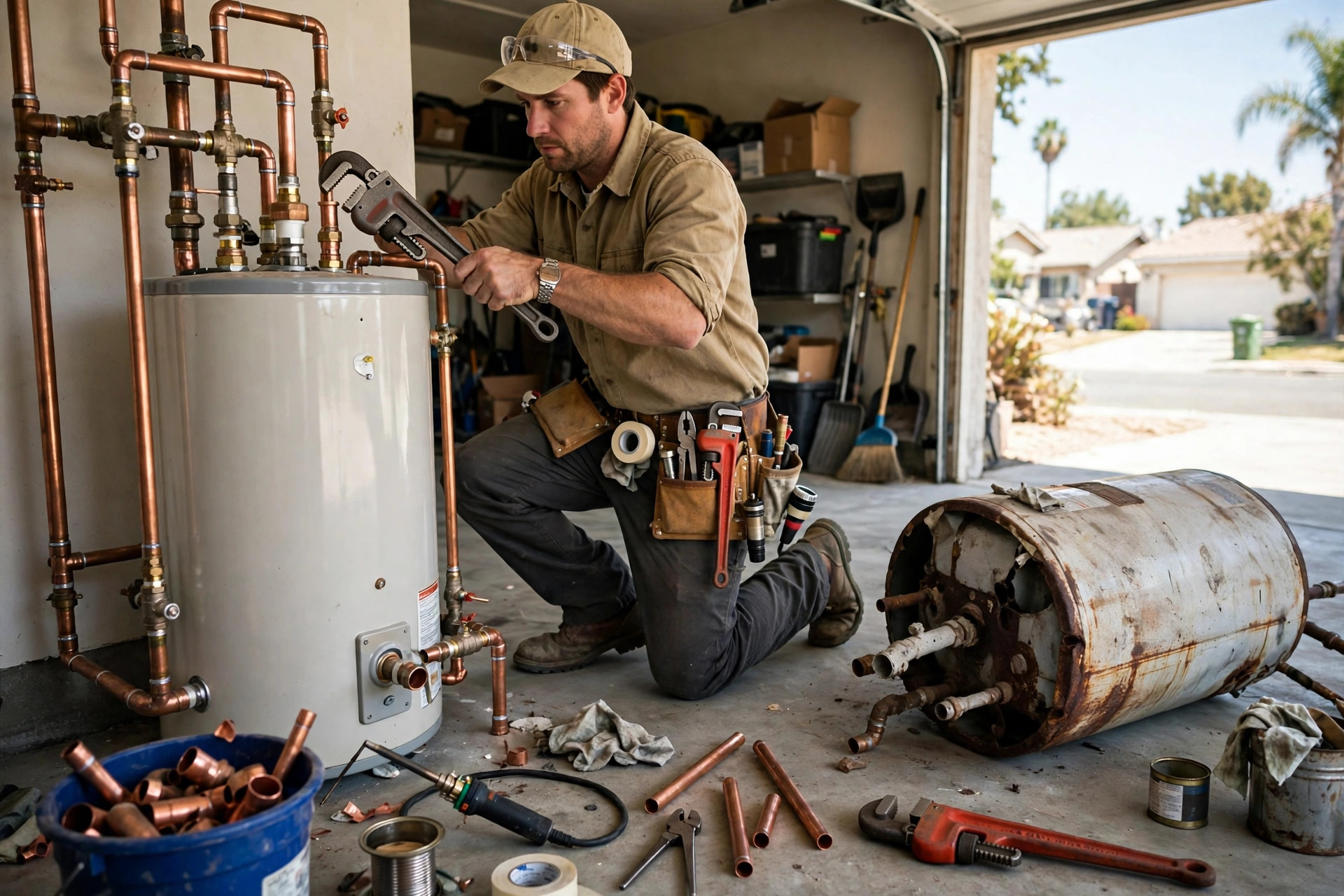
Most Los Angeles homeowners think about their water heater only twice: when it is installed, and when it fails. Between those two moments, hard water, pressure, and age quietly decide how long the heater will last and how well it will serve the household. A replacement done in a hurry, with the same size and the same setup as the failed unit, often repeats the conditions that shortened the old heater's life. A replacement planned around the house, the water, and the family's actual use has a much better chance of lasting, delivering steady hot water, and avoiding the leak that damages floors, garages, and rooms below.
This guide walks through water heater installation and replacement as Los Angeles homeowners actually experience it: the choice between repairing and replacing, how tank size is really decided, why hard water at 200 to 400-plus parts per million matters, and how seismic safety, pressure, and housing type change the job. It covers tank and tankless trade-offs in brief, the details of a tank replacement in older homes, and the timing question every owner faces when a heater is ageing but has not yet leaked. The goal is not to push a particular unit, but to help you recognise a thorough replacement plan and avoid a rushed one.
How a storage water heater works, and why Los Angeles is hard on tanks
A storage heater keeps a tank of water hot around the clock, reheating it whenever the temperature drops or hot water is drawn. A burner or electric elements heat the water, insulation slows heat loss, and a thermostat keeps the tank ready for the next shower, load of laundry, or dishwasher cycle. That simplicity is the tank's strength: it delivers a large volume quickly, handles simultaneous use well, and does not depend on a high gas flow or complex electronics to the same degree as a tankless unit. It is also the tank's weakness in Los Angeles, because the same water sits in the tank for hours, giving dissolved minerals time and heat to form scale, and giving corrosion a steady environment in which to work.
Los Angeles water commonly measures 200 to 400-plus parts per million of hardness, and scale builds on the tank bottom, on elements, and around the burner area. That layer insulates water from heat, forces longer heating cycles, and overheats the tank bottom, which stresses the glass lining that protects the steel. Once the lining cracks, corrosion accelerates, and a tank that looked fine from the outside can begin to leak. Homes built between 1948 and 1965 often add sediment and rust from galvanized supply lines, and hillside homes add water pressure over 80 PSI, which strains the tank, relief valve, and fittings. A tank in Los Angeles therefore ages on several fronts at once, and age alone is a poor guide without looking at water, pressure, and maintenance history.
Repair or replace: how to judge an ageing heater
The repair-or-replace decision usually turns on age, condition, and the cost of repeated fixes rather than on any single symptom. A relatively young tank with a faulty thermostat, element, or valve may be a sensible repair, especially if it has been flushed, its anode rod is in reasonable shape, and there is no rust or leaking at the base. A tank that is well past its expected life in a hard-water area, has never been flushed, shows rust streaks or dampness at seams, or has already needed several repairs is usually a replacement candidate, because the next failure is often the tank itself leaking rather than a small part that can be swapped. Spending on parts for a corroded tank can delay the inevitable by months while leaving the leak risk in place.
Capacity and household change also belong in the decision. A tank sized for two people will frustrate a family of five, and a tank that once served a household well may no longer match it after children grow, a bathroom is added, or an accessory dwelling unit is occupied. Efficiency matters too: an old, heavily scaled tank costs more to run for less hot water, and a replacement can restore capacity and efficiency at the same time. The practical test is simple: if the tank is old, scaled, rusting, or repeatedly repaired, and the household's needs have grown, replacement usually makes more sense than another repair. If the tank is young, sound, and simply has a failed component, repair is usually the wiser first step.
Sizing a tank for a Los Angeles household
Tank sizing is about peak demand, not about matching the old tank's label. The old tank may have been undersized from the start, oversized for a household that has since shrunk, or chosen for a house before a bathroom addition. A useful sizing conversation counts people, bathrooms, and overlapping use: morning showers that run at the same time, laundry that runs while someone showers, and a dishwasher that starts after dinner. A large soaking tub changes the calculation more than an extra sink does, because filling it can draw a large share of a tank in one go. A household that showers in sequence has very different needs from one that showers simultaneously, even if both homes have the same number of bathrooms.
Recovery rate matters as much as tank volume. Recovery is how quickly the heater reheats water after use, and it decides how long the household waits between heavy uses. A larger tank with slow recovery can still run out during back-to-back demand, while a smaller tank with fast recovery may keep up better than its size suggests. Los Angeles inlet water temperature also matters: colder winter inlet water takes longer to heat and reduces effective capacity. A good replacement plan weighs tank size, recovery, fuel type, and the family's real schedule together, rather than copying the previous tank or picking the largest unit that fits the closet.
Tank, tankless, and hybrid trade-offs in plain terms
A conventional tank remains the right choice for many Los Angeles homes because it is straightforward, handles simultaneous use well, and fits the gas, venting, and space arrangements that older homes already have. Its drawbacks are standby heat loss, a finite supply that can run out, and the eventual risk of a tank leak. A tankless unit removes the stored-water leak risk and offers endless hot water within its flow limits, but it needs more gas capacity, specific venting, and disciplined descaling in hard water. A hybrid heat-pump water heater can use far less energy, but it needs space, airflow, and a suitable location, and it behaves differently in a cool garage or tight closet than in an open utility room.
The choice should follow the house and the household, not a general claim that one type is always best. A home with limited gas capacity and a tight venting route may be a poor tankless candidate but an excellent tank candidate. A home with very high simultaneous demand and a suitable gas supply may benefit from tankless or from a larger, faster-recovery tank. A household that prioritises lower running costs and has a suitable location may find a hybrid worth examining. What matters is that the trade-offs are named before installation: capacity, running cost, space, venting, gas, maintenance, and leak risk all pull in different directions, and the best replacement is the one whose compromises fit that particular home.
What a thorough tank replacement includes in an older home
A tank replacement is more than swapping one cylinder for another. The old unit must be drained and removed safely, the new unit must sit level and stable, and connections for water, gas or electricity, venting, and drainage must suit the new model. Seismic strapping is essential in Los Angeles: a tank that can topple or shift in an earthquake risks broken gas and water connections, so straps must anchor the tank properly to wall framing, not merely loop around it loosely. A drain pan and drain route matter where a leak would damage finished floors or rooms below, which is a real concern in multi-story homes and condos. The temperature and pressure relief valve and its discharge route must be correct, because that valve is a key safety device, not a decorative fitting.
Older Los Angeles homes often reveal extra work once the old heater is out. Corroded connectors, a failing shutoff valve, a vent that no longer suits the new unit, or a gas connection that needs attention can all surface at replacement time. In Craftsman homes, access through a crawlspace or a tight utility area can slow the work and limit unit size, while in Torrance slab homes, supply lines under the slab mean rerouting decisions differ from homes where pipes run through an accessible crawlspace. A thorough installer checks the shutoff, expansion and pressure situation, venting, and drainage before promising a completion time, because discovering these issues mid-job is how a simple replacement turns into a long, disruptive day.
Hard water, pressure, and seismic safety after replacement
A new tank installed into the same hard-water, high-pressure conditions as the old one will age on the same path unless those conditions are addressed. Flushing the tank at least annually removes sediment before it hardens into a thick insulating layer, and checking the anode rod gives early warning that corrosion protection is spent. The anode rod is a sacrificial component that corrodes so the tank does not, and once it is gone, tank corrosion accelerates. In Los Angeles hard water, anode and flushing schedules matter more than in soft-water cities, and homes in Glendale and other very hard areas should treat maintenance as part of owning the heater, not as an optional extra.
Pressure deserves the same attention. Hillside homes where pressure exceeds 80 PSI need a working pressure-reducing valve, and a valve that has drifted or failed can expose a new tank to the same stress that shortened the old one. Seismic straps should be checked after any earthquake, remodel, or heater work, because a strap loosened during other work protects nothing. Together, flushing, anode checks, pressure control, and seismic strapping form the maintenance system that lets a new tank reach a reasonable life in Los Angeles. A replacement that ignores all four may look identical on installation day and fail years earlier than it should.
Signs by room and area that point to heater trouble
Heater problems rarely announce themselves only at the heater. In bathrooms, the signs are showers that go lukewarm sooner than they used to, temperature that swings when another tap opens, or hot water that takes much longer to arrive. In kitchens, a dishwasher that leaves dishes less clean or a tap that delivers only brief hot water can point to capacity or scale problems. In laundry rooms, a washing machine that seems to use cooler water than expected may be drawing from a scaled, struggling tank. Around the heater itself, listen for popping or rumbling during heating, look for rust streaks, white mineral crust, or dampness at the base and connections, and note any puddle, however small.
Location changes what a leak costs. A garage heater leak spreads across concrete and may damage stored items, but a closet heater on an upper floor can damage ceilings, walls, and floors below before anyone notices. In Torrance slab homes, a leak near the heater can be confused with a slab leak elsewhere, so damp flooring, warm spots, or rising damp near the heater area deserve prompt investigation rather than being dismissed as spill. In Craftsman homes with crawlspaces, a slow leak may show first as dampness or musty smells below the floor. Noting where symptoms appear, when they started, and which fixtures are affected helps separate a heater problem from a pipe, pressure, or fixture problem.
What to check before you call, and timing a replacement well
Before calling, note the heater's age if the rating plate is visible, how long hot water lasts at peak use, and whether problems affect the whole house or only one bathroom. Check whether flushing or anode work has ever been done, whether pressure symptoms such as banging pipes or unusually forceful fixtures are present, and whether the heater sits in a garage, closet, or upper floor where a leak would matter most. Note recent changes: a new bathroom, more occupants, a remodel, or a change in water hardness clues such as faster scale on showerheads. These details let a technician judge repair versus replacement and size a new unit without guessing.
Timing a replacement before failure is often wiser than waiting for a leak, especially for a tank in a hard-water area that is ageing and has never been maintained. A planned replacement lets the household choose size, type, and timing, and lets the installer check gas, venting, pressure, and drainage without flood damage in the background. An unplanned failure, by contrast, forces a fast decision under stress, often with water already spreading. If a tank is old, scaled, and located where a leak would cause serious damage, planning its replacement during a calm week is a practical form of home protection, not an unnecessary expense.
City-by-city notes for replacement planning
Glendale and Burbank combine very hard water with many older homes, so replacement planning there should include flushing, anode checks, and water treatment in the same conversation as tank size. Pasadena and foothill areas add older housing stock and longer pipe runs, where a tank's recovery and location affect wait times at distant bathrooms. Santa Monica and coastal condos often face space, venting, and drainage constraints, and a tank that fits the closet and drains safely matters more than a marginally larger tank that cannot be serviced. Long Beach and Torrance include many post-war slab homes, where heater placement and slab pipe routing shape replacement options and leak consequences.
In the San Fernando Valley, larger homes with multiple bathrooms make peak-demand sizing especially important, while hillside areas across the city add pressure control to every replacement plan. Central Los Angeles Craftsman homes bring crawlspace access and older galvanized lines into the picture, so a replacement should include a look at supply-line condition, not just the tank. Across all these areas, the pattern is consistent: Los Angeles replacements fail early when they copy the old setup without checking water, pressure, seismic strapping, and household demand. A replacement that names those local factors is the one most likely to serve the household well for years.
Planning a replacement around your household and home
A planned replacement should fit the household's week, not just the installer's schedule. Clear access to the heater, the shutoff, and any crawlspace or closet route, and know in advance how long water will be off while the old unit is drained and the new one is connected. Larger households should plan showers, laundry, and cooking around that window, and pets or home workers should have a quiet room away from the work area. If the heater sits in a tight closet or an upper floor, ask how the old unit will be removed and the new one brought in, because a route that looks simple on paper can be awkward with a full-size tank in a narrow hallway.
After installation, the walkthrough matters as much as the fitting. Every fixture should be checked for hot water, temperature stability, and leaks at new connections, and the household should leave with a clear record of the unit, its installation date, and the flushing and anode schedule that suits Los Angeles water. Keep that record with other home documents, because it helps the next technician judge age and maintenance without guessing. Note the pressure reading and the condition of seismic straps at handover, and ask what signs should prompt a call, such as rumbling, rust, dampness, or a sudden loss of capacity. A replacement that ends with that briefing is far easier to maintain than one that ends with the installer simply leaving.
Frequently asked questions
How long should a water heater last in Los Angeles?
Life varies with water hardness, pressure, maintenance, and use. In hard-water areas, a tank that is never flushed or checked can fail years earlier than a maintained one, which is why flushing and anode checks matter as much as the unit itself.
Should I replace my heater before it leaks?
If the tank is old, scaled, rusting, or repeatedly repaired, and a leak would damage finished rooms, planning a replacement before failure is often wiser than waiting. A planned job allows proper sizing and checks without flood damage in the background.
Why does my new heater need flushing if it is new?
Flushing removes sediment before it hardens into scale that insulates the tank bottom and stresses the lining. In Los Angeles hard water, starting the flushing habit early protects the new tank from the same ageing path as the old one.
Can I keep the same size tank as before?
Sometimes, but the old size may have been wrong for the current household. Peak demand, bathroom additions, tub use, and recovery rate should be checked, rather than assuming the previous choice still fits.
Related service
Call Los Angeles Plumbing Pros
If you are seeing the signs in this post, describe what you see, where it is, and when it started. A technician will talk through the next step before any work starts.