
Water Filtration and Reverse Osmosis in Los Angeles: Taste, Sediment, and Hard Water
Los Angeles Plumbing Pros Blog — 30 Oct 2026
Los Angeles tap water is treated to be safe to drink, but safe and pleasant are not the same thing in every kitchen. Chlorine taste and odour, sediment from older pipes, and the sheer hardness of local water — commonly 200 to 400-plus parts per million, and over 12 grains per gallon in Glendale — all change how water tastes, how it looks in a glass, and how it treats coffee, ice, and cooking. Water filtration and reverse osmosis, often shortened to RO, are two different answers to that problem, and choosing between them depends on what you are actually trying to fix at your tap.
This post explains how whole-house filtration and under-sink reverse osmosis each work in a Los Angeles home, what Los Angeles water and housing do to both systems, what signs point to filtration rather than softening, how a system is diagnosed and sized, and what maintenance keeps it working. It also covers city-by-city differences, from older apartments in Santa Monica and Culver City to hillside homes where pressure over 80 PSI changes how a system must be installed.
How filtration and reverse osmosis work in a Los Angeles home
Whole-house filtration usually starts with a sediment filter that catches sand, rust, and other particles, followed by a carbon filter that reduces chlorine taste and odour and some organic compounds that affect flavour. It treats water as it enters the house, so every tap, shower, and appliance benefits, but it does not remove dissolved hardness minerals in the way a softener does. That distinction matters in Los Angeles: a carbon filter can make water taste better and protect fixtures from sediment, but it will not stop scale from forming inside a water heater fed by very hard water.
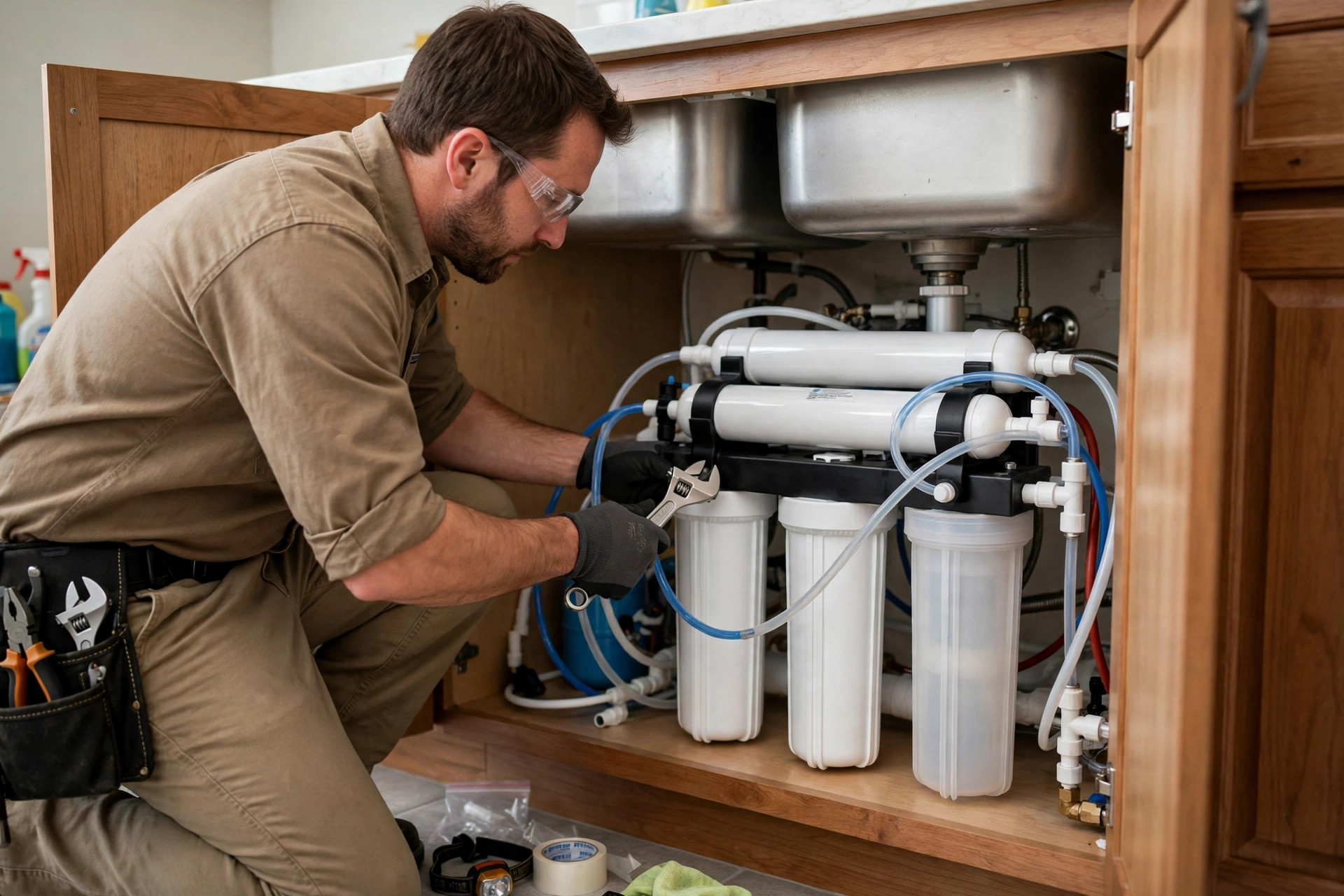
Reverse osmosis works at a single point of use, usually under the kitchen sink, and it works much more thoroughly at that tap. Water is pushed through a semi-permeable membrane that allows water molecules through while holding back a large share of dissolved solids, along with pre-filters that remove sediment and chlorine first so the membrane is not damaged. The filtered water is stored in a small tank and delivered through a dedicated faucet, while the rejected water goes to the drain. That is why RO water often tastes noticeably cleaner for drinking and cooking, and why it is paired with a separate faucet rather than replacing the main kitchen tap. The trade-off is flow: an RO tank holds a limited volume, it refills slowly, and it produces drain water as part of the process, so it is a drinking-water system, not a whole-house system.
Why Los Angeles water and housing change the choice
Los Angeles water varies by source, season, and neighbourhood, and that variation shows up at the tap as changes in taste, chlorine character, and hardness. A home in Glendale dealing with very hard water over 12 grains per gallon may need softening for scale and filtration for taste as two separate jobs, while a home nearer the coast may find taste and sediment are the main complaints and hardness, while still present, is less extreme. Treating every Los Angeles home as if it had the same water leads to the wrong system: a carbon filter alone will disappoint a household that expected it to end scale, and a softener alone will disappoint a household that expected it to end chlorine taste.
Housing age adds sediment and flow problems that filtration must handle. Homes built between 1948 and 1965 with sections of galvanized steel piping can release rust and sediment, especially after water has sat overnight or after work on the street main disturbs the supply. That sediment clogs pre-filters faster, shortens membrane life in an RO system, and can make a shower or faucet sputter. Hillside homes bring pressure into the calculation: pressure over 80 PSI can stress filter housings, RO fittings, and supply lines, while very low pressure in some elevated or distant parts of a property can leave an RO system slow to refill. Older apartments in Santa Monica and Culver City, with shared walls, shared risers, and older fixtures, may have sediment and taste problems that are building-wide, and a single under-sink RO unit can solve drinking water for one unit even when the building supply itself is unchanged.
Signs by room and area that filtration or RO is the answer
In the kitchen, the signs are sensory. Water that tastes strongly of chlorine, ice that carries an off taste into a drink, coffee that tastes flat or bitter despite fresh beans, and a kettle that scales quickly all point to water quality at the tap, but they point to different fixes. Chlorine taste alone suggests carbon filtration. Scale plus taste suggests a combination of softening and filtration. Cloudy water that clears from the bottom up is often just air, while water that stays cloudy or carries visible particles points to sediment that a pre-filter should catch.
In the bathroom, filtration signs are subtler. A shower filter can reduce chlorine feel on skin and hair for some people, but it will not soften hard water or stop scale on glass, so a bathroom that spots heavily while the kitchen tastes fine is telling you hardness, not just taste, is at work. In the laundry room, filtration alone rarely explains stiff towels or detergent problems; those are hardness signs. In the garage or utility area, a whole-house filter housing that clogs quickly, a pressure drop across the filter, or rust-coloured water after a period of disuse all suggest sediment load from older piping. Outside, hose water that carries grit after street work is a reminder that sediment is a system-wide issue, not a single-tap problem, and that pre-filtration protects everything downstream of it.
Diagnosis steps: testing, pressure, and existing plumbing
Diagnosis starts by separating taste, sediment, and hardness, because each needs a different test. A taste and odour description, plus when it appears — first thing in the morning, after the tap has run, or all day — helps distinguish chlorine character from sediment or a problem inside a single faucet. A hardness reading in parts per million or grains per gallon tells you whether scale is part of the story, and a total dissolved solids reading at an RO tap, compared with the unfiltered tap, shows whether an existing RO membrane is still performing or has reached the end of its useful life.
Next comes the plumbing check. A technician will look at the main line material and age, especially galvanized sections from the 1948 to 1965 era, the location and condition of any existing filter housings, household pressure, and the space under the kitchen sink for an RO tank, drain connection, and dedicated faucet. In a hillside home, pressure over 80 PSI must be addressed before a new filter housing or RO fitting is put under stress, and in a home with low pressure, RO production rate and tank size need to be discussed honestly, because a system that refills slowly will frustrate a large household. In an older apartment, the check will also note who controls the main supply, whether a whole-house filter is even possible for one unit, and whether an under-sink RO system is the practical answer for drinking water.
Filtration and RO options and the trade-offs between them
The first trade-off is scope. Whole-house filtration improves every tap for taste and sediment, but it does not produce RO-quality drinking water at the kitchen sink and it does not soften water. Under-sink RO produces high-quality drinking and cooking water at one tap, but it does nothing for the shower, the dishwasher, or the water heater. Many Los Angeles households therefore combine the two: whole-house sediment and carbon filtration for the house, plus RO at the kitchen sink for drinking, or a softener for hardness plus RO for drinking, depending on which problems are actually present.
Within RO, trade-offs include tank size, production rate, and drain ratio. A larger tank serves a family that fills bottles, pots, and kettles in quick succession, but it takes more under-sink space. A system with a higher production rate refills faster but may need adequate pressure to perform as described. Some systems add a remineralisation stage that puts a small amount of minerals back for taste, which some households prefer and others do not notice. Whole-house systems have their own trade-offs: larger filter housings hold more media and need changing less often, but they take more space and cost more upfront, while smaller housings are easier to fit in a tight garage or utility closet but clog faster in a home with heavy sediment from older galvanized piping.
What to check before calling Los Angeles Plumbing Pros
Before calling, describe the problem in sensory terms: what the water tastes like, whether it smells of chlorine, whether it carries particles, whether it spots glassware, and whether the problem is at every tap or only at one. Note when it started, whether it changed after street work, a renovation, or a long absence, and whether other homes nearby report the same taste. That timing often separates a supply change from a problem inside your own piping or an ageing filter.
Also note the practical facts that decide what can be fitted. Under the kitchen sink, is there space for a tank and a dedicated faucet, and is there a drain connection available? Is there an existing filter, softener, or RO system, and when were its filters last changed? In an older apartment in Santa Monica or Culver City, note whether the issue is building-wide and who controls access to the main supply. In a hillside home, mention pressure if you know it, especially over 80 PSI, and in a home with galvanized piping, mention rust colour or sediment, because a system that is not protected by a pre-filter will fail early in that environment. A clear description of taste, sediment, hardness signs, and available space lets a technician recommend filtration, RO, softening, or a combination, rather than guessing from a single complaint.
Photographs can help as well, especially a picture of the space under the sink, the existing filter housing, or sediment in a glass after the tap has run for a few seconds. Those details show whether a standard housing will fit, whether a larger housing is needed for heavy sediment, and whether the drain and faucet layout will work without major cabinet changes. They also help avoid a visit that ends with a recommendation that cannot be fitted in the space available.
If you already have a filter or RO system, note the brand and model if it is visible, and whether the dedicated faucet drips, the tank takes a long time to refill, or the water has changed taste recently. Each of those clues points to a different part of the system, from a tired membrane to a tank that has lost pressure, and knowing them in advance can turn a general check into a targeted repair.
Prevention and maintenance for Los Angeles water quality
Filtration and RO systems only work while their consumables are changed. Carbon filters lose their ability to reduce taste and odour as they saturate, sediment filters clog and reduce flow, and RO membranes gradually lose performance, especially if chlorine reaches them because a carbon pre-filter was left too long. Keeping to the change schedule for your water use and sediment load matters more than the calendar alone: a home with heavy sediment from older galvanized piping may need pre-filter changes sooner than a newer home, and a household that uses a lot of RO water will exhaust a membrane sooner than a single-person household.
Maintenance also means checking the parts around the filters. Housings should be inspected for cracks and for seals that have hardened, drain lines from an RO system should be checked for kinks and proper air gap, and the storage tank should be checked for pressure and for any change in taste that suggests it needs sanitising. In hillside homes, a pressure check belongs in the same routine, because pressure over 80 PSI stresses housings and fittings over time, and in coastal areas such as Santa Monica and Long Beach, exposed fittings deserve a corrosion check. A softener, where one is also installed, should be maintained alongside filtration, because softened water still benefits from carbon filtration for taste, and filtered water still needs softening for scale in very hard areas such as Glendale.
City-by-city notes across Los Angeles
In Glendale and Burbank, very hard water means filtration is rarely the whole answer on its own. Households there often combine sediment and carbon filtration for taste with softening for scale, and RO at the kitchen sink for drinking, because each system solves a different part of the water problem. Pasadena's foothill homes share that hardness pattern, with larger houses, more bathrooms, and garages where a whole-house system can be fitted with room for future filter changes, which makes maintenance easier over time.
Santa Monica and Culver City show the apartment pattern most clearly. Older buildings with shared walls and shared risers may have sediment and taste issues that affect many units, and an under-sink RO system can give one household excellent drinking water without waiting for a building-wide project. Long Beach and Torrance, with coastal exposure and post-war housing, combine sediment from older piping with corrosion on exposed fittings, so filter housings in garages and outdoor areas need protection and regular inspection. In central Los Angeles, the mix of older single-family homes and apartment buildings means the first step is often a simple separation of problems: is this taste, sediment, hardness, or all three, and which system, or combination, matches the answer for that house?
Frequently asked questions
Does reverse osmosis remove hardness from Los Angeles water?
At the tap it serves, yes, RO reduces dissolved solids including hardness minerals, which is why RO water tastes clean and does not spot a kettle. It does not soften water for the whole house, however, so showers, dishwashers, and water heaters on other taps still receive hard water unless a separate softener is installed.
Will a whole-house carbon filter stop scale in my water heater?
No. Carbon filtration improves taste and reduces chlorine and sediment, but it does not remove dissolved calcium and magnesium. In Los Angeles water at 200 to 400-plus parts per million, scale will continue to form in a heater unless hardness itself is addressed with a softener or another hardness treatment.
Why does my RO system produce water to the drain?
RO works by pushing water through a membrane and carrying rejected dissolved solids away in a drain stream. That drain water is part of normal operation, not a leak, although a system that drains constantly when the tank is full, or that never stops running, should be checked for a faulty valve or fitting.
How often should RO filters and membranes be changed?
Pre-filters and carbon filters are changed most often, and membranes last longer, but the exact interval depends on water use, sediment load, and chlorine exposure. Homes with older galvanized piping and heavy sediment will need pre-filter changes sooner, and a falling production rate or a rise in dissolved solids at the RO tap are signs a change is due.
Can I install RO in an older Santa Monica or Culver City apartment?
Usually yes, if there is space under the kitchen sink for a tank, a drain connection, and a dedicated faucet. An under-sink system does not need access to the building main, which makes it practical for a single unit even when the building supply itself is shared and unchanged.
Does high hillside pressure affect filtration?
Yes. Pressure over 80 PSI can stress filter housings, seals, and RO fittings, and it can shorten their life. A pressure check before installation, and a pressure-reducing valve where pressure is consistently high, protects both filtration equipment and the rest of the plumbing system.
Related service
Call Los Angeles Plumbing Pros
If taste, sediment, or hardness is showing up at your taps, describe what you taste and see, whether it is at every tap or only one, and what filtration or softening you already have. A technician will talk through the next step before any work starts.