
Trenchless Sewer Replacement in Los Angeles: No-Dig Options for Old Clay and Cast-Iron Laterals
Los Angeles Plumbing Pros Blog — 30 Oct 2026
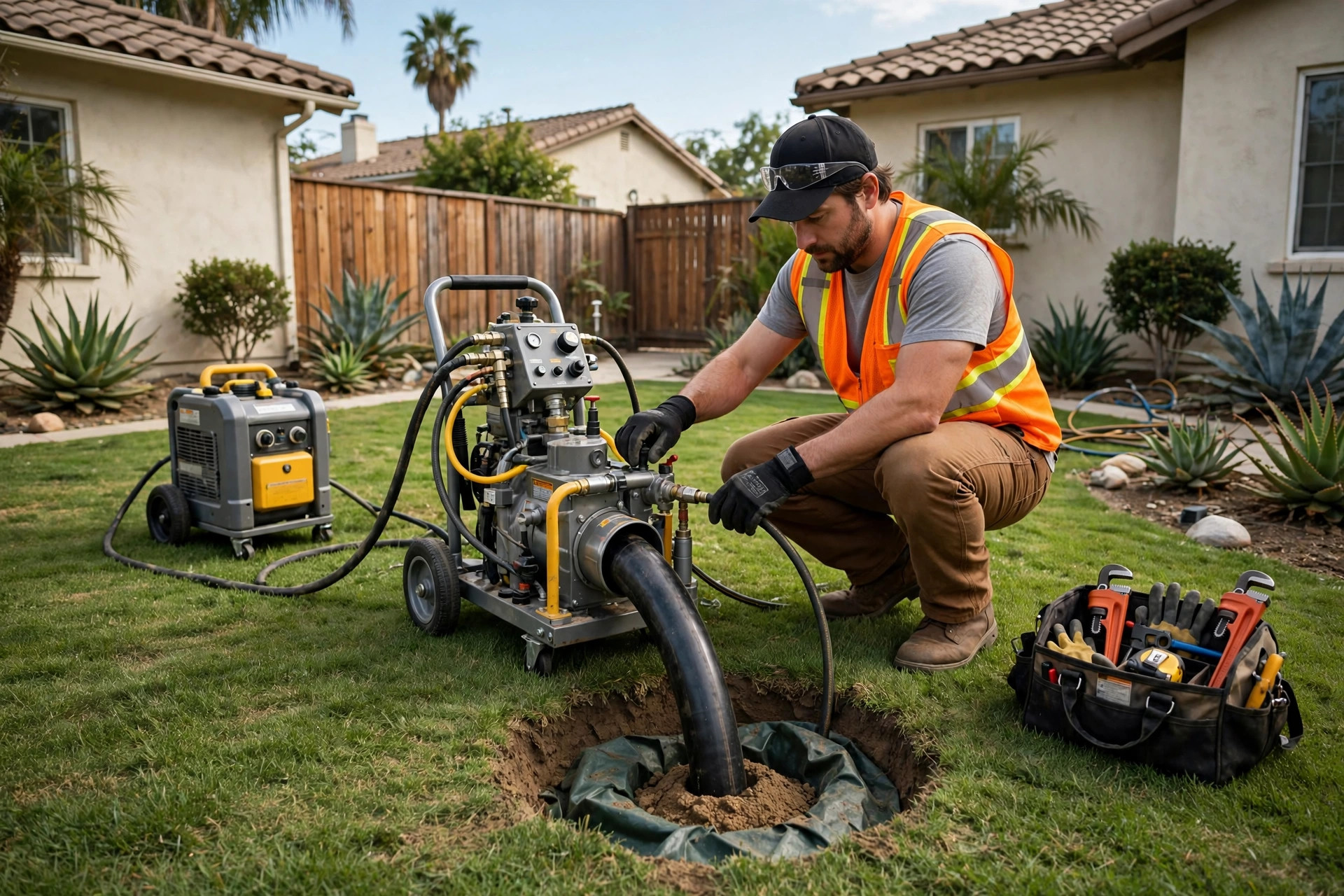
Many Los Angeles sewer lines were laid decades before trenchless methods existed, and they are now failing under streets, driveways, mature gardens, and concrete patios that homeowners understandably do not want torn apart. Trenchless sewer replacement offers a different path: a new pipe is installed through small access points, often at the ends of the existing line, instead of digging a long open trench from the house to the street. For homes in Pasadena, Glendale, Los Feliz, Hancock Park, and other established neighbourhoods, where front yards are landscaped, driveways are wide, and sidewalks and street trees are part of the character of the block, that difference matters a great deal. It can mean keeping a mature tree, a tiled walkway, or a recently resurfaced driveway intact while still solving a sewer problem that will only get worse if it is left alone.
This post explains how trenchless replacement works in Los Angeles conditions, when it is a good fit, and when a traditional repair is still the wiser choice. It looks at the clay and cast-iron laterals common across the city, the oak, sycamore, and pepper tree roots that find their way into old joints, the effect of hillside pressure and shifting soil, and the hard water and aging galvanized supply lines that often accompany an old sewer in the same house. Understanding those local factors helps a homeowner ask better questions, recognise a genuine sewer failure early, and avoid both unnecessary digging and a trenchless job attempted on a line that is not a suitable candidate.
Why Los Angeles sewer laterals fail
A sewer lateral is the pipe that carries wastewater from a home to the city main, usually under the front yard and the street. In much of Los Angeles, that lateral was built from clay pipe in sections joined with mortar or similar materials, or from cast iron that has now had many decades of service. Clay sections are strong in compression, but their joints are vulnerable. As soil moves, as roots press against them, and as the ground settles after winter rain, joints can shift, crack, and open just enough for roots and soil to enter. Cast iron, meanwhile, corrodes from the inside over time, especially where wastewater sits, where hard water leaves mineral deposits, and where older household plumbing adds sediment and rust to the flow. Neither material was designed to last forever, and in homes built in the 1948 to 1965 period and earlier, the lateral may be as old as the house itself.
Los Angeles soil and climate add further stress. Much of the city sits on expansive or shifting soils that swell with winter rain and shrink in dry months, and hillside areas experience movement that puts bending stress on a rigid pipe. Earthquake shaking, even small tremors over many years, can disturb joints that were already weak. Tree roots are another major factor. Oaks, sycamores, and pepper trees are planted widely across Los Angeles, and their roots seek moisture year-round in a dry climate. A tiny opening at a clay joint releases moisture and nutrients, and roots grow toward it, enter the pipe, and expand. Once inside, they catch paper, grease, and debris, slow the flow, and eventually block the line or break the joint further. The result is often a pattern of repeated backups that drain cleaning clears for a time but does not cure.
How trenchless replacement works
Trenchless replacement usually takes one of two main forms, and the choice depends on the condition of the old pipe, its depth, its diameter, and what lies above it. In pipe bursting, a bursting head is pulled through the old line, breaking it outward into the surrounding soil while a new pipe, often made from a continuous length of high-density polyethylene, is pulled in behind it along the same path. In lining, a flexible liner saturated with resin is inserted into the existing pipe, inflated against its walls, and cured in place to form a new pipe inside the old one. Both methods use access pits rather than a continuous trench. The pits are typically dug at the house end and near the street connection, and the work between them happens underground, out of sight.
Before either method is chosen, a camera inspection is essential. A camera run through the lateral shows the pipe material, the location of breaks, offsets, bellies where the pipe sags and holds water, root masses, and any section that has collapsed completely. That inspection also measures length and depth and identifies connections, bends, and places where a lateral joins the city main. In Los Angeles, that step matters because a line that looks like a simple root problem from the surface may turn out to have a collapsed section, a severe offset, or a belly that lining alone cannot correct. A careful inspection protects the homeowner from a trenchless repair that fails early and from an open trench dug for a line that could have been replaced with far less disturbance.
When trenchless is a good fit in Los Angeles
Trenchless replacement is often a strong fit when the lateral runs under features that would be costly or disruptive to restore, such as a concrete driveway in Burbank, a mature garden in Pasadena, a tiled patio in Beverly Hills, or a sidewalk and parkway tree in Santa Monica. It is also attractive on narrow lots in Los Feliz or Silver Lake, where there is little room to stage excavation equipment and where an open trench would block access for days. Homes on hillsides, where an open trench can destabilise a slope and where access for heavy equipment is limited, may also benefit, provided the slope, soil, and pipe alignment have been properly assessed. In these cases, the value is not only in the new pipe but in what is preserved above it.
The condition of the pipe is just as important as what sits above it. Trenchless bursting works well when the old pipe can be broken outward and the new pipe can follow the same alignment. Lining works well when the host pipe is still largely in place, even if it is cracked or root-damaged, and can support the liner while it cures. A line with repeated root intrusion at joints, with longitudinal cracks, or with corrosion that has thinned the wall but not collapsed it, may be a candidate. A line that has already collapsed, that has a major offset where one section has dropped away from the next, or that has a deep belly holding standing water, may need a different approach, at least for that section. A responsible assessment explains which sections are suitable and which are not, rather than promising a trenchless solution for every foot of pipe.
When a traditional repair is still the better choice
There are Los Angeles laterals where digging is the honest answer, and recognising them early saves money and disappointment. If a camera shows a fully collapsed pipe, the bursting head or liner cannot reliably pass through it, and attempting to force the issue can damage neighbouring utilities or leave a new pipe misaligned. If the pipe has a severe belly, a new pipe installed inside or along the same sagging alignment will inherit the same drainage problem, because wastewater will still pool in the low spot. If the lateral is very shallow, if it runs close to gas, water, or electrical lines that cannot be safely bypassed, or if the connection to the city main is damaged, an open repair at that point may be necessary even if the rest of the line can be handled trenchlessly.
Permits and city requirements also shape the decision. Work that touches the public right of way, the sidewalk, or the connection to the city main in Los Angeles usually involves inspection and coordination with the city, and the condition of that connection can only be confirmed by inspection. In some cases, a hybrid job is the best outcome: a trenchless replacement for the long run under the yard and driveway, combined with a small open excavation at the street connection or at a collapsed section. Homeowners should be wary of any proposal that skips the camera inspection, that does not explain how the street connection will be handled, or that treats every lateral as identical. Los Angeles lots vary enormously, from flat post-war tracts in the San Fernando Valley to steep hillside parcels above the city, and the right method follows the pipe, not a sales script.
Roots, hard water, and the rest of an aging Los Angeles system
A failing sewer lateral rarely exists in isolation in an older Los Angeles home. The same house may have galvanized supply lines from the 1948 to 1965 building era that are narrowing with rust and mineral scale, a water heater struggling with hard water at 200 to 400-plus parts per million, and hillside water pressure over 80 PSI that stresses fixtures and joints throughout the system. Those problems are separate, but they share a cause: decades of service in hard, mineral-rich water and in soil that moves. A homeowner planning a sewer replacement should therefore think about the whole system, not just the lateral. If supply lines are already delivering low pressure and rust-coloured water, if a heater is rumbling with scale, or if a pressure-reducing valve is failing on a hillside lot, those issues deserve attention in their own right, even if they are not part of the sewer job itself.
Roots deserve special attention after a trenchless replacement. A new continuous pipe with fused joints removes the many entry points that clay sections offered, which is one of its main advantages in neighbourhoods shaded by oaks, sycamores, and pepper trees. That does not mean roots disappear from the yard, and it does not protect other old pipes on the property, such as a remaining clay section near the house or a separate drain line. Keeping trees watered away from the sewer alignment where possible, avoiding planting new large-rooted trees directly over the lateral, and having the line camera-checked periodically are sensible habits. Winter rain also matters: heavy rain can saturate soil, increase movement, and expose a weak lateral that coped during dry months. A backup that first appears during a winter storm is often a sign of a problem that was already present, not a problem caused by the rain alone.
What to expect during the work and afterwards
Most trenchless jobs begin with marking utilities, confirming the camera findings, and digging the access pits. The pits are smaller than a full trench, but they are still excavations, and the soil, concrete, or paving removed from them needs to be restored. Homeowners should ask where the pits will be, how large they will be, how the surface will be restored, and how long water use in the home will be interrupted. In many cases, the interruption is shorter than with a full open trench, because less digging is involved, but the home will still need to limit water use while the old line is out of service and the new pipe is being installed and tested. Testing matters: a new lateral should be checked for alignment, for a sound connection at both ends, and for proper flow before the pits are backfilled.
Afterwards, the signs of success are straightforward. Drains should run freely, backups that recurred every few months should stop, gurgling and slow flushing should clear, and damp patches or odours near the old lateral alignment should not return. It is still worth keeping records of the work, including the camera footage before and after, the length and material of the new pipe, and the location of the access pits and the street connection. Those records help future plumbers, help a buyer understand the home, and make any later work on the property faster and less invasive. If a problem does return, a camera inspection is again the first step, because it distinguishes a new issue, such as a blockage in an interior drain, from a failure of the replacement itself. A new pipe does not make the rest of the plumbing new, and honest follow-up keeps expectations realistic.
Planning, permits, and restoration for a trenchless job
Planning a trenchless replacement in Los Angeles involves more than choosing between bursting and lining. The first practical step is confirming where utilities run, because a lateral often shares a corridor with water, gas, electrical, and communications lines, and the access pits must be placed where they will not disturb those services. Utility marking and a careful examination of the camera footage, including depth measurements along the line, help the crew choose pit locations that are safe and workable. On a narrow lot, that may mean using a side yard or a driveway edge rather than the centre of a landscaped front yard, and on a hillside lot, it may mean accounting for slope stability and for how equipment will reach the pits without damaging retaining walls or terraces.
Coordination with the city is another part of planning, particularly where the lateral connects to the city main or crosses a sidewalk or street. That connection is a critical point: if it is damaged, misaligned, or blocked by roots, the new lateral will not drain properly even if the run under the yard is perfect. The work at the connection may involve inspection and approval, and the homeowner should understand in advance who is responsible for each portion of the line, what inspection is required, and how the surface will be restored after the connection work. A proposal that does not mention the street connection, or that treats it as an afterthought, is incomplete, because the connection is where many sewer jobs succeed or fail.
Restoration deserves the same attention as the pipe itself. Access pits disturb soil, paving, and planting, and the quality of the backfill and surface repair determines whether the yard settles, whether a driveway patch cracks, and whether a sidewalk section remains level. Homeowners should ask how pits will be backfilled and compacted, what surface material will be used for restoration, and how planting or irrigation disturbed by the work will be handled. In a mature Los Angeles garden, saving a tree or a hedge during the pipe work is only a partial success if irrigation lines are cut and not restored, or if soil compaction damages roots that were not directly in the trench. A clear restoration plan, agreed before work starts, avoids disputes afterwards and protects the landscaping that made trenchless work attractive in the first place.
Finally, timing and household preparation matter. A trenchless job still interrupts water use for a period, and the household should know when that interruption will occur, how long it is expected to last, and what to do if it runs longer than planned. Keeping the camera footage, the permit and inspection records, and a diagram of the new pipe alignment and pit locations is useful long after the crew leaves. That record helps a future plumber locate the line, helps a buyer or inspector understand what was done, and helps the homeowner distinguish a new drainage problem from a problem with the replacement. Trenchless replacement is a significant investment in a home, and treating the planning, the city coordination, and the restoration as part of the job, rather than as extras, is what turns a new pipe into a lasting improvement.
Frequently asked questions
Can trenchless replacement handle tree roots in a clay lateral?
Yes, in many cases, because a new continuous pipe removes the joints that roots entered through. A camera inspection first confirms whether the pipe is intact enough for bursting or lining, or whether a collapsed or severely offset section needs a different repair.
Does trenchless work avoid all digging?
No. Trenchless work still needs access pits at the ends of the line, and sometimes a small excavation at the street connection. The saving is that it avoids a long open trench across the yard, driveway, or sidewalk.
How do I know if my Los Angeles lateral needs replacement rather than cleaning?
Repeated backups, a camera showing cracks, offsets, bellies, or heavy root intrusion, and a lateral made from old clay or cast iron are strong signs. Cleaning clears a blockage, but it does not repair a broken pipe, so a pattern of recurring problems points toward replacement.
Related service
Call Los Angeles Plumbing Pros
If you are seeing the signs in this post, describe what you see, where it is, and when it started. A technician will talk through the next step before any work starts.