
Tankless Water Heater Installation in Los Angeles: Sizing, Hard Water, and What to Expect
Los Angeles Plumbing Pros Blog — 30 Oct 2026
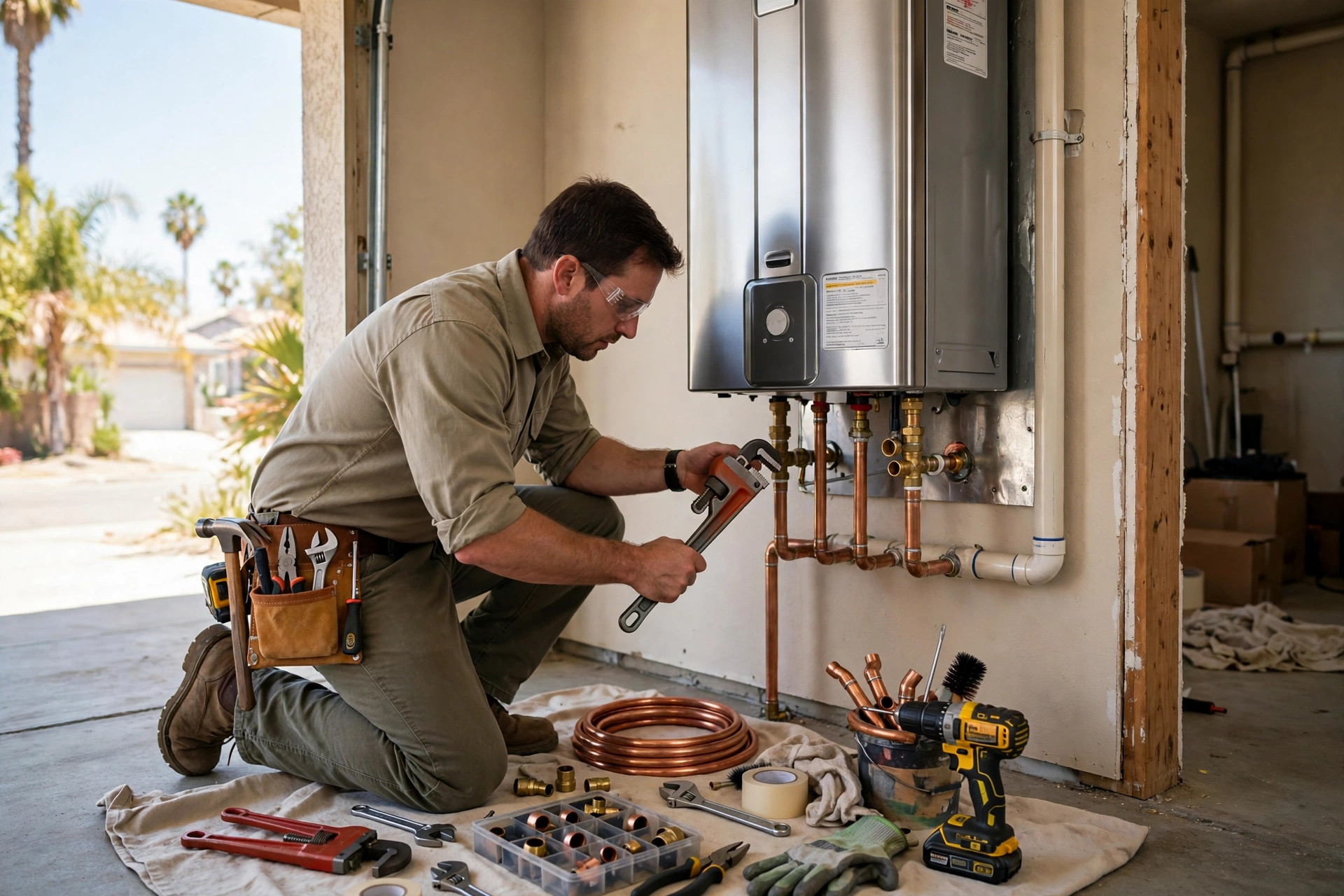
A tankless water heater does not store a full tank of hot water and keep it warm all day. Instead, it heats water only when a tap, shower, dishwasher, or washing machine calls for it, passing cold water through a heat exchanger and sending it out hot a few seconds later. For many Los Angeles households, that design is appealing because it frees up floor space, removes the risk of a large tank leaking, and can keep up with back-to-back showers when it is sized and installed correctly. The catch is that tankless performance depends far more on the details of the house than a conventional tank does, and Los Angeles adds its own complications, from very hard water to older gas lines, tight garage closets, and hillside water pressure that can run well above comfortable levels.
This guide explains how tankless installation actually works in Los Angeles homes, what makes a system perform well or disappoint, and how to tell whether tankless is the right fit for your household. It covers sizing for real Los Angeles families, the effect of hard water at 200 to 400-plus parts per million, gas and venting requirements in older homes, and the maintenance that protects a heat exchanger in this city. If you live in a Craftsman with a crawlspace, a Torrance slab home, a hillside house, or a condo with limited venting options, the same tankless unit can behave very differently, and those differences matter more than the brand name on the box.
How a tankless heater works in a Los Angeles home
The practical result is that flow rate and temperature rise must be considered together, not separately. A unit rated for a high flow at a small temperature rise will deliver far less when it must raise cold winter water by a large amount. Los Angeles households also tend to use water in bursts: morning showers overlap, laundry runs while someone showers, and a dishwasher starts after dinner. A good installation accounts for those overlaps rather than assuming one tap at a time. Controls, recirculation, and pipe layout all affect how quickly hot water arrives at a distant bathroom, and in a long, single-story Los Angeles ranch or a two-story home with bathrooms at opposite ends, wait time can be a bigger daily frustration than total capacity.
Why Los Angeles hard water changes the tankless equation
Los Angeles water commonly measures 200 to 400-plus parts per million of hardness, and in Glendale it runs over 12 grains per gallon, which is firmly in the very hard range. That hardness is dissolved calcium and magnesium, and it drops out as scale whenever water is heated. In a tank, scale settles and insulates the bottom. In a tankless unit, scale coats the narrow passages of the heat exchanger, where even a thin layer narrows flow, forces the burner to work harder, and can cause temperature swings, error codes, and early failure. A tankless unit in a soft-water city might go years with little attention, but the same unit in Los Angeles needs a descaling plan from the start, and homes at the high end of the hardness range need it most.
Scale is not the only Los Angeles water issue. Many homes built between 1948 and 1965 still have galvanized steel supply lines, which corrode from the inside, narrow with rust, and shed sediment that can reach a tankless inlet filter and reduce flow. Hillside homes add another stress: water pressure over 80 PSI strains valves, fittings, and the heater itself, and can make temperature control less stable. A tankless installation in Los Angeles therefore starts with water, not just with the heater. Checking hardness, pressure, and the condition of the supply lines helps decide whether a softener or filter, a pressure-reducing valve, or pipe work should come first, because installing a sensitive new heat exchanger on top of untreated hard, high-pressure, sediment-heavy water shortens its life.
Sizing a tankless unit for a real Los Angeles household
Sizing begins with counting what runs at the same time, not with counting bathrooms. A shower typically draws more than a bathroom sink, a washing machine draws in bursts, and a dishwasher draws less but runs for a long time. A household of two people who rarely overlap showers has very different needs from a family of five in Pasadena where two showers, laundry, and a kitchen tap can all run on a Saturday morning. A single person in a Santa Monica apartment may be comfortable with a smaller unit, while a larger home in the San Fernando Valley with three bathrooms, a large soaking tub, and a high-flow shower system may need a larger unit or a different approach entirely. The goal is steady temperature at peak use, not a headline flow number measured under ideal conditions.
Fixture habits matter as much as fixture counts. Low-flow showerheads reduce demand and make tankless sizing easier, while rain showers, body sprays, and large tubs raise it sharply. A tub that takes a long time to fill at a high flow can dominate the calculation, and some households choose to accept a slower tub fill in exchange for endless showers. Climate matters too: a unit sized for Los Angeles summer inlet temperatures should still be checked against winter inlet temperatures, when the required temperature rise is greatest. A careful installer will ask about morning routines, tub use, laundry timing, and future plans such as adding a bathroom, because sizing for today's habits and ignoring tomorrow's addition is a common reason tankless owners end up disappointed.
Gas supply, venting, and space in older Los Angeles homes
Most gas tankless units need a larger gas supply than the tank heater they replace, because heating water instantly takes far more burner power than keeping a tank warm slowly. In older Los Angeles homes, the existing gas line may have been sized decades ago for a tank heater, a furnace, and a stove, with no spare capacity for a high-input tankless burner. If the gas line is too small, the unit may starve for gas when other appliances run, causing temperature swings or shutdowns. Checking gas line size, length, and total appliance load is therefore part of a proper tankless job, and in some homes a gas line upgrade is the difference between a system that works and one that frustrates its owners from the first week.
Venting and location bring their own Los Angeles constraints. Tankless units vent differently from old tank heaters, and the vent route, clearances, and condensate handling must suit the specific unit and the house. A garage closet that worked for a tank may be too tight, too poorly ventilated, or too far from a suitable vent termination for a tankless unit, and condos and townhomes often have stricter limits on where a vent can exit. Seismic safety matters as well: Los Angeles homes need heaters secured against earthquake movement, with gas connections protected so that shaking does not turn a water heater problem into a gas problem. A good installation plan settles location, venting, gas capacity, and seismic strapping before the old heater is removed, not after.
Signs your home is a good tankless candidate, and signs it is not
Tankless tends to suit households that value endless showers, have limited space, or are replacing a tank that leaked and damaged a floor. Homes with steady, overlapping shower use, a garage or exterior wall with a workable vent route, adequate gas capacity, and a willingness to descale annually are strong candidates. Tankless also suits households planning a remodel, because the freed floor space and wall-mounted design can open up a cramped utility closet or garage corner. If your current tank is old, undersized for your family, or located where a leak would damage finished rooms below, the case for tankless grows stronger, provided the sizing and water-treatment details are handled honestly.
Tankless is a weaker fit when gas capacity cannot be upgraded practically, when venting options are severely limited, when the household regularly runs several very high-flow fixtures at once, or when hard water will go completely untreated and maintenance will be ignored. Homes with extremely low flow fixtures can also present a challenge, because a tankless unit needs a minimum flow to fire, and a trickle from a single low-flow tap may not trigger it. None of these factors automatically rules tankless out, but each one should change the plan: a larger unit, a storage-assisted design, a softener, a recirculation system, or in some cases staying with a well-sized tank may serve the household better than forcing a tankless unit into unsuitable conditions.
How diagnosis works before an installation is quoted
A useful tankless assessment starts with questions and measurements, not with a unit picked from a catalogue. Expect questions about how many people live in the home, when showers overlap, whether anyone uses a large tub, and how often laundry and dishwashing coincide with showers. The installer should check the current heater's size and age, look at the gas meter and gas line routing, measure static and running water pressure, and note the hardness clues in the home, such as white scale on showerheads and aerators. In homes with galvanized lines from the 1948 to 1965 era, the condition of those lines matters, because restricted, rusted pipes can limit flow before the new heater ever gets a chance to perform.
The physical survey should also cover venting routes, condensate drainage, electrical supply for controls and freeze protection, and access for future descaling. A unit tucked where its service valves cannot be reached will not get descaled, however good the owner's intentions are. Seismic strapping, drain pans where required, and clearances around the unit should be noted at this stage. Homes on hillsides, where pressure regularly exceeds 80 PSI, need a pressure check and, where needed, a pressure-reducing valve plan. A diagnosis that skips gas, water, pressure, and venting and jumps straight to a unit size is incomplete, and Los Angeles homes punish that shortcut more than most, because hard water and old infrastructure expose weak planning quickly.
Installation options and trade-offs to understand
The main choice is between a single properly sized unit and a design that adds help for distance or peak demand. A single unit is simpler and often sufficient for small to medium homes with moderate overlap. A recirculation system, either dedicated or on-demand, can cut wait time at distant bathrooms, which matters in long Los Angeles homes where a bathroom at the far end can take a long time to receive hot water. Recirculation adds complexity and energy use, and it must be designed so it does not constantly cycle the heater or scale it faster in hard water. Some larger homes use two units or a tankless unit paired with storage, trading simplicity for capacity and redundancy, so one failure does not leave the whole house without hot water.
Water treatment is another trade-off. A softener protects the heat exchanger from scale and also protects fixtures, dishwashers, and washing machines, but it needs space, salt or maintenance, and a drain. A scale-inhibiting filter is smaller and simpler but does not soften water as completely. Isolation valves and service ports are not glamorous, yet they decide whether annual descaling is a straightforward job or a difficult one, and they are worth insisting on. Condensing tankless units offer higher efficiency and different venting and condensate needs than non-condensing units, and the right choice depends on gas, venting, and drainage realities in the specific home, not on efficiency numbers alone.
What to check before you call, and what to note down
Before calling, gather a few facts that make the assessment far more useful. Note how many people use hot water at peak times, which fixtures run together, and whether temperature swings happen now with your current heater. Check whether showers go cold when laundry starts, whether flow drops when two taps open, and whether white scale builds quickly on showerheads and faucet aerators. Look at your current heater's location and take note of venting, nearby gas appliances, and whether the space is a garage, closet, crawlspace-adjacent utility area, or exterior wall. In a Craftsman home, note whether access runs through a crawlspace; in a Torrance slab home, note that pipes run under the slab and rerouting options differ from homes with accessible crawlspaces.
Also note pressure symptoms: banging pipes, dripping relief valves, or fixtures that seem unusually forceful can point to hillside pressure over 80 PSI. Note any gas smell, soot, or yellow burner flames on existing gas appliances, and do not ignore them: if you smell gas, leave the area and follow emergency guidance rather than investigating the heater yourself. Photograph the rating plate on the current heater if it is safe and easy to reach, because its capacity and age help with sizing. Writing down when problems happen, which fixtures are involved, and what changed recently gives the technician a pattern to work from, instead of a single vague complaint that could point in several directions.
Prevention and maintenance for Los Angeles tankless owners
Annual descaling is the single most important maintenance task for a tankless unit in Los Angeles, and in the hardest-water areas it may be needed more often. Descaling flushes a cleaning solution through the heat exchanger to dissolve scale before it narrows passages and stresses the burner. The inlet filter should also be cleaned, because sediment from older galvanized lines or municipal work can restrict flow and mimic a heater failure. Keeping service valves accessible, and keeping a record of each descaling, makes it easy to spot when scale is building faster than expected, which can point to a water-treatment problem rather than a heater problem. Households that skip descaling often notice the same progression: slightly cooler showers, then temperature swings, then error codes and shutdowns.
Beyond descaling, watch pressure and seismic safety over time. A pressure-reducing valve that drifts upward can expose the heater and the whole house to high pressure again, so periodic pressure checks matter, especially on hillsides. Seismic straps should stay tight and intact, and gas connections should be checked if the home has been shaken or remodelled. Aerators and showerheads deserve regular cleaning in hard water, both for flow and as an early warning: if scale returns quickly after cleaning, the water treatment or descaling schedule needs attention. A softener, where installed, needs its own upkeep, and a neglected softener protects nothing. Together, these small habits are what separate a tankless unit that lasts from one that scales up and fails early in Los Angeles.
City-by-city notes across Los Angeles
Glendale and Burbank sit at the hard end of the Los Angeles water range, so tankless owners there should plan descaling as a routine, not an occasional task, and should take softening seriously. Pasadena and the foothill communities combine hard water with many older homes, where galvanized lines, tight utility closets, and longer pipe runs to distant bathrooms are common. Santa Monica and coastal homes may have somewhat different water sources and milder inlet swings, but condos there often face the tightest venting and space limits, and a tankless plan must start with what the building allows. Long Beach and Torrance include many post-war slab homes, where the heater location and pipe routing under the slab shape what can be changed without major disruption.
Hillside neighbourhoods, from the Hollywood Hills to parts of the San Fernando Valley, add pressure to the list: a tankless unit installed without a pressure check can face stress that shortens valve and seal life. In the Valley, larger homes with multiple bathrooms and high-flow fixtures make sizing and recirculation planning especially important, while smaller Craftsman homes in central Los Angeles often have crawlspaces that help access but complicate venting and gas routing. The lesson across all of these areas is the same: Los Angeles is not one water system, one housing stock, or one pressure zone, and a tankless installation that ignores the neighbourhood's water, housing age, and terrain is guessing. A local assessment that names those factors is worth more than a generic recommendation.
Frequently asked questions
How often does a tankless heater need descaling in Los Angeles?
Once a year is a practical starting point for most Los Angeles homes, and homes in the hardest-water areas may need it more often. If showers start fluctuating or flow drops, scale should be checked before assuming the unit itself has failed.
Will a tankless heater work with my old galvanized pipes?
It can, but restricted galvanized lines can limit flow and shed sediment that clogs the inlet filter. The pipe condition should be checked during sizing, because replacing or bypassing badly restricted sections may be needed for the new unit to perform as expected.
Does tankless mean instant hot water at every tap?
No. Tankless means endless hot water once it arrives, not instant arrival. Distance from the heater still causes a wait, and a recirculation design is what shortens that wait in long homes with distant bathrooms.
What if my gas line is too small for a tankless unit?
The gas line, meter load, and total appliance demand need to be checked before installation. In some homes the line can be upgraded; in others the plan may change to a different unit size or design. This check should happen before the old heater is removed.
Related service
Call Los Angeles Plumbing Pros
If you are seeing the signs in this post, describe what you see, where it is, and when it started. A technician will talk through the next step before any work starts.